How Much Should a Cat Eat Per Day?
“How much should I actually feed my cat?”
This is one of the most common questions cat owners ask in Saudi Arabia.
Some people free-feed.
Some follow the feeding chart exactly.
Others reduce portions because they worry about weight gain.
The right amount depends on your cat’s weight, age, activity level, and whether they live fully indoors.
Let’s simplify it.
Why Portion Control Matters for Indoor Cats in Saudi Arabia
Most cats in Riyadh, Jeddah, and other Saudi cities:
-
Live in apartments
-
Spend most of the day indoors
-
Have limited activity
-
Are sterilized
-
Stay in air-conditioned environments
Because of this lifestyle, indoor cats burn fewer calories than outdoor cats.
Even a small daily calorie surplus can lead to gradual weight gain over time.
Measured feeding helps prevent this.
How Many Calories Does a Cat Need Per Day?
Here are general daily calorie needs for healthy adult indoor cats:
2–3 kg cat
Approximately 140–180 kcal per day
4 kg cat
Approximately 200–250 kcal per day
5 kg cat
Approximately 240–300 kcal per day
These numbers are averages. Individual needs vary.
Always adjust based on body condition, not just numbers.
How to Convert Calories Into Actual Food Portions
Every food formula has a different calorie density.
Dry food contains more calories per gram than wet food.
Example:
If a dry food contains 380 kcal per cup
And your 4 kg cat needs 220 kcal daily
You would feed slightly more than half a cup per day.
Always check the feeding chart printed on the package.
You can explore dry food options here:
https://sadeeqy.com/collections/cats-dry-food
For mixed feeding, remember that wet food calories must also be counted.
Wet food options:
https://sadeeqy.com/collections/cats-wet-food
General cat food collection:
https://sadeeqy.com/collections/cats-food-treats
Should You Free-Feed or Schedule Meals?
Free feeding often leads to:
-
Gradual weight gain
-
Boredom snacking
-
Difficulty monitoring intake
Most indoor cats do better with:
-
Two measured meals per day
or -
A measured daily portion divided into smaller servings
Structured feeding improves weight control.
How Much Should a Kitten Eat?
Kittens grow quickly during their first year.
They require:
-
Higher calories
-
Higher protein
-
More frequent meals
General feeding structure:
Up to 4 months
3–4 small meals daily
4–6 months
3 meals daily
6–12 months
2–3 meals daily
Always use kitten-specific formulas during this stage.
Kitten options:
https://sadeeqy.com/collections/kitten-essentials
How Sterilization Affects Feeding
After sterilization:
-
Appetite often increases
-
Metabolism may slightly decrease
This is when many indoor cats begin gaining weight.
Switching to indoor or sterilized formulas is commonly recommended for better calorie balance.
Seasonal Appetite Changes in Saudi Arabia
During extreme summer heat:
-
Some cats eat slightly less
-
Activity decreases
-
Water intake may fluctuate
During cooler months, appetite may increase.
Monitor weight monthly instead of reacting to short-term appetite changes.
Signs You May Be Feeding Too Much
-
You cannot easily feel your cat’s ribs
-
Waist is no longer visible from above
-
Belly appears rounded
-
Noticeable weight gain over 1–2 months
Gradual portion adjustments work better than sudden restriction.
Signs You May Be Feeding Too Little
-
Visible ribs
-
Low energy
-
Persistent hunger behavior
-
Noticeable weight loss
Balanced feeding supports stable energy and coat health.
Simple Feeding Checklist for Saudi Indoor Cats
-
Weigh your cat monthly
-
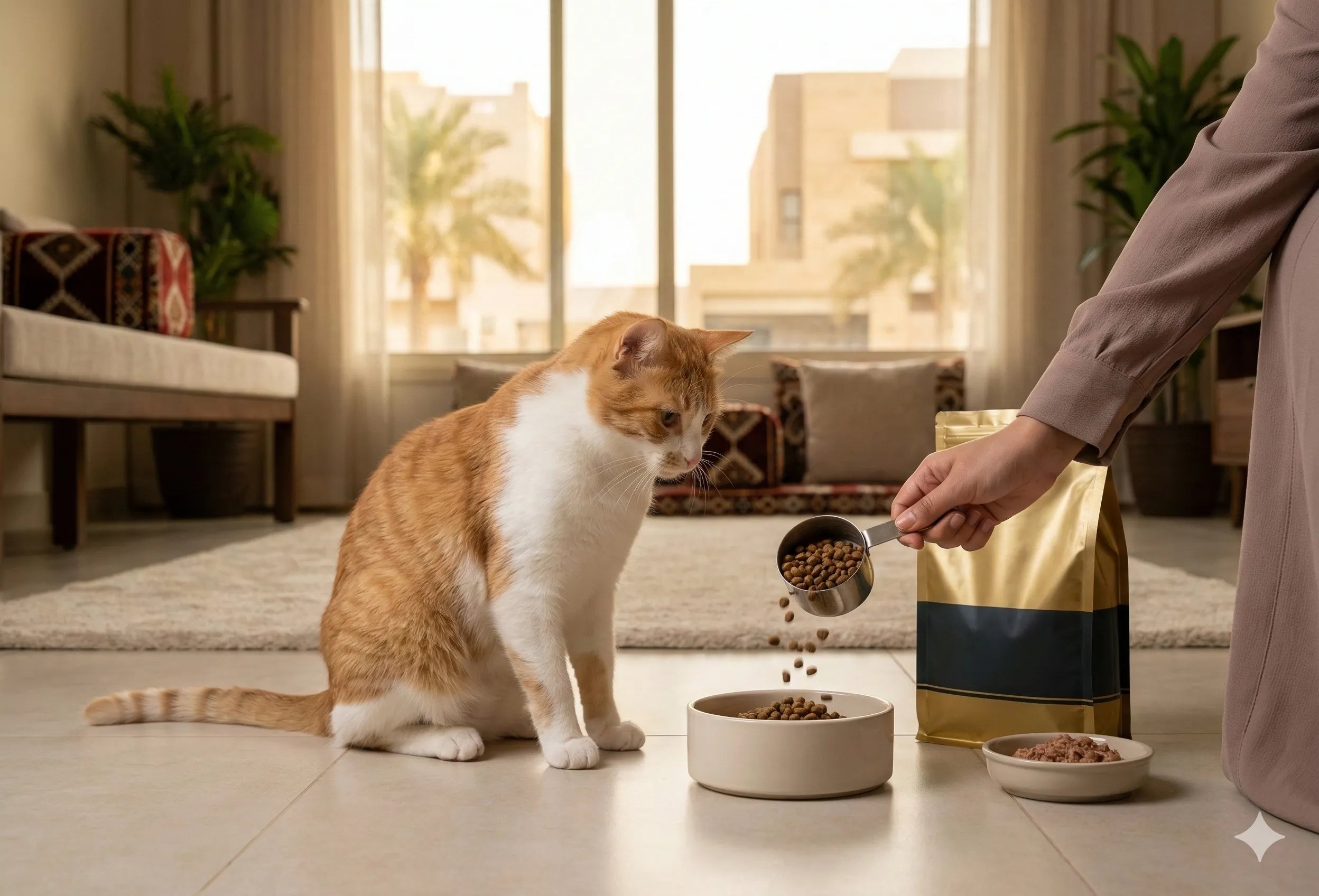
Measure food using a cup or scale
-
Avoid topping dry food without adjusting portions
-
Include wet food if hydration is a concern
-
Adjust portions gradually
Consistency matters more than perfection.
Final Reassurance
You do not need complex calculations every day.
Start by:
-
Checking your cat’s weight
-
Following the feeding chart
-
Measuring portions instead of guessing
Small, consistent adjustments prevent long-term health problems.